Blog

  • Human sight and touch are connected to the deep sea by an underwater robot.

    Human sight and touch are connected to the deep sea by an underwater robot.

    Underwater robot
    Underwater robot

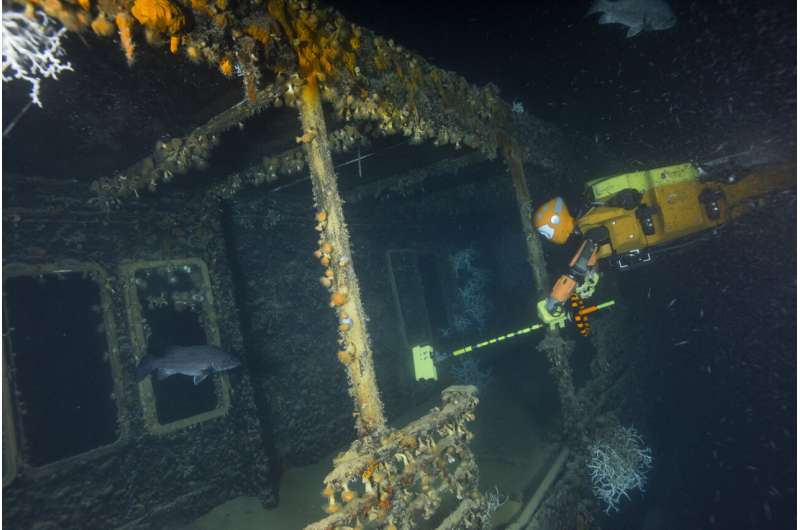
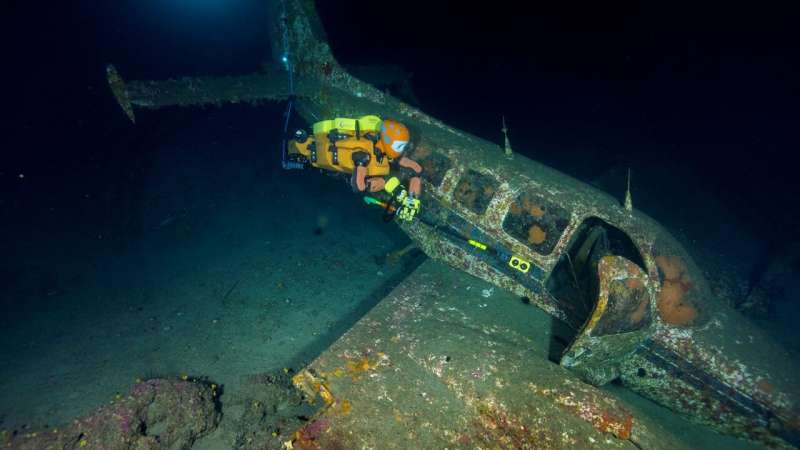
    Stanford University roboticist Oussama Khatib experienced a sense of presence when the underwater robot OceanOneK cautiously maneuvered near the top deck railing of the sunken Italian vessel Le Francesco Crispi this month, 500 m (about a third of a mile) below the Mediterranean’s surface.

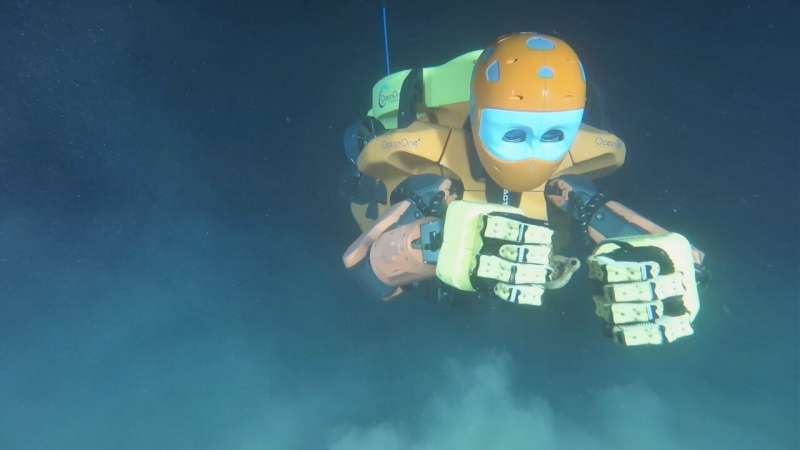
    humanoid top half and a slimmer back half with eight multi-directional thrusters that allow careful maneuvering underwater. The robot’s haptic—or touch-based—feedback system and stereoscopic vision produced incredibly realistic sensations that equaled what he would have experienced were he down below, rather than above onboard the control ship. Peering through OceanOneK robot’s eyes and feeling through its hands, Khatib perceived a kaleidoscope of life—pink and green and rusty-orange—layered on and around the ship. He felt the resistance of the water and could discern the shapes and proximity of the historic relic around him.

    “You are moving very close to this amazing structure and something incredible happens when you touch it: You actually feel it,” said Khatib, who is the Weichai Professor in the School of Engineering and director of the Stanford Robotics Lab. “I’d never experienced anything like that in my life. I can say I’m the one who touched the Crispi at 500 m. And I did—I touched it, I felt it.”

    OceanOneK’s voyage to these depths has two objectives: to explore previously unexplored territory and to demonstrate that human touch, vision, and interaction can be conveyed to locations that are far from where people can function.

    The main achievement of the team, which included the crew of the ship, Denis Degez and Franca Cibecchini from DRASSM, Vincent Creuze from LIRMM at the University of Montpellier, Michel L’Hour, the former director of underwater archaeology research in France’s Ministry of Culture (DRASSM), and Michel L’Hour, was demonstrating functional autonomy at nearly 1,000 m below the surface. This development led to OceanOne’s rebranding as OceanOneK.

    This is the first time a robot has been able to interact with the environment at such a level and let the human operator experience it, according to Khatib. It has been a fantastic journey,

    First deep dig

    February’s dive to the Crispi had been part of a multi-stop tour of the Mediterranean for OceanOneK that started in September 2021 with two stops near Marseille to a World War II P-38 Lightning aircraft at 40 m (about 130 ft) and a submarine, Le Protée, at 124 m (roughly 400 ft). The third was to a second-century Roman ship in Aléria, Corsica at 334 m (nearly 1100 ft) and the Crispi was next.

    A search for suitable weather then urged the team toward Cannes. There, the robot’s boom camera had its first use in viewing inside the cockpit of a Beechcraft Baron F-GDPV aircraft that was 67 m down (over 200 ft). The final dive was to 852 m—over a half mile down—where, on pausing for a thruster check, the team found, worrisomely, that the robot was unable to ascend. OceanOneK was fully functioning but flotations around the communication and power line connecting to topside had collapsed, leaving the long, heavy line piled on top of the robot. Pulling in the slack, they were able to continue the dive.

    Two OceanOne

    OceanOneK robot’s expedition to the 1 km mark was long in the works. It started with countless hours of design, experimentation, and assembly with fellow team members in the lab, dozens of trips to the Stanford pool for debugging, and myriad lessons-to-be-learned before facing the unpredictability of the real world.

    The predecessor of OceanOneK, OceanOne had been built for reaching depths at most around 200 m. To bring the robot deeper, the researchers adapted its body with special foam made of glass microspheres that provide buoyancy while being capable of withstanding the immense pressure at 1 km depths—pressure over 100 times the experience at sea level. Furthermore, the robot’s arms were filled with an oil and spring mechanism that compresses the oil to match the outside pressure, preventing collapse and cushioning the electronics. The researchers also updated many tiny components throughout OceanOne to minimize the amount of compressible air residing in individual parts and keeping the robot as compact as possible.

    Two new types of hands were included in OceanOneK, one created by Stanford University researcher Mark Cutkosky’s team and the other by Professor Antonio Bicchi of the University of Pisa and the Italian Institute of Technology (IIT).

    In a troubled mood

    Over the past few years, swimmers at Stanford’s Avery Recreation Pool may have observed OceanOneK swimming while researchers experimented with various techniques and technologies. The equipment includes carrying crates for objects and a boom-mounted camera that would allow them to look inside confined and difficult-to-reach areas—areas where the robot couldn’t go.

    The Stanford Robotics Lab graduate student Adrian Piedra remarked, “It was many months of testing, during COVID, twice a week, until everything—touch, control, and vision—worked without a hitch.”

    Such planning was advantageous in many ways, but it was particularly helpful when the team’s first voyage required them to repair OceanOneK’s amputated limb. This necessitated disassembling the robot on the boat’s deck at night, in the wind, and during a storm, according to Khatib. Adrian Piedra and Wesley Guo, two of our brave pupils, never stopped trying to fix the robot. Everyone on board was astounded by their tenacity, tenacity, and ultimate triumph, according to Khatib.

    “The robot has so many features and so many inter-related components that if there’s one part broken, we may need as much as a full day in dismantling, repairing, and reassembling,” said Stanford Robotics Lab graduate student Bo Kim, who traveled with OceanOne and collaborated from campus for OceanOneK. “Everything has to meld together and operate concurrently to achieve a good expedition, and that is very tough.”
    Underwater robot

    The expedition in July

    Following some issues with their initial trip, the crew received a second chance to dive to the Roman ship and the Crispi this summer. The team attempted—but failed to succeed—in removing an oil lamp from the Roman ship when they first came into contact with it. A malfunction with the arm prevented the boom camera from being used at the Crispi in February. For the dives in July, everything was in motion.

    Under the direction of the team’s archeologists, OceanOneK dove to the Roman ship once more and was successful in bringing back a number of priceless antique vases dating to the Roman Empire, some of which had never been seen in DRASSM’s collections before. These discoveries were unusual because the manufacturer’s name and label were still visible on them, demonstrating the advantages of diligent super-deep artifact recovery.

    Khatib dove to the Crispi again, this time extending the boom camera into the broken hull without touching the edges. He was led by the team’s marine biologist, who avidly watched as the external corals gave way to the inside rusticles, rust formations in the shape of icicles that revealed the results of nearly 80 years of bacterial contact with the ship’s iron.
    Underwater robot

    both in the past and the future

    Piedra claimed that in hindsight, he has started to comprehend the wider picture, how significant the difficulties they faced were, and how enormous the task they completed is.

    We travel all the way to France for the expedition, and once there, among a larger group of people with diverse backgrounds, you realize that the component of the robot you’ve been working on at Stanford is actually a part of something much greater, he added. You can understand the significance of this, how innovative and momentous the dive will be, and what this means for science as a whole.

    The OceanOne project incorporates cutting-edge developments in haptics, underwater robotics, and human-robot interaction. It also creates new opportunities for marine science and underwater engineering activities, such as inspecting and maintaining boats and infrastructure, such as bridge piers and underwater pipelines.

    Other missions are planned in many different places throughout the globe, including lost towns buried beneath deep lakes, coral reefs, and archeologically significant wrecks at depths so far beyond human reach that OceanOneK presents a singular opportunity to comprehend the past.
    Read More

  • This is a stick-based robot

    This is a stick-based robot

    This a stick-based robot
    This a stick-based robot

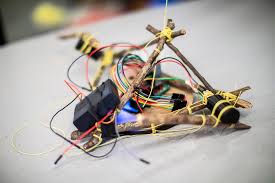
    Devin Carroll stepped outside of his apartment in the late summer and picked up a few sticks that he thought would work for his robot as the leaves were beginning to crisp and curl from the heat. He stripped the three sticks of their bark and made them about half an inch thick and the length of an adult hand. He then tied them with twine to StickBot, a modular robot made up of circuitry, actuators, a microcontroller, and a motor driver.

    StickBot is now propelled across the table at Penn’s General Robotics, Automation, Sensing & Perception (GRASP) Lab by four AA batteries, a tangle of wires, and blinking lights. Carroll is a Ph.D. candidate in the School of Engineering and Applied Sciences.

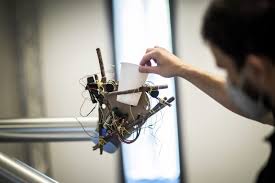
    Carroll demonstrates how StickBot can go from using the sticks as arms to utilizing them as legs by controlling it with an app he created. In “grasper mode,” the sticks move with their free end to hold a cup upright while being hinged to a controller plate on one side.

    Carroll demonstrates how StickBot can go from using the sticks as arms to utilizing them as legs by controlling it with an app he created. In “grasper mode,” the sticks move with their free end to hold a cup upright while being hinged to a controller plate on one side.

    StickBot is an idea, an adaptable system that can be set up in various ways, not a fixed, unique innovation. StickBot is a modular robot, meaning that parts can be added, changed, or removed as needed.

    Mark Yim, Carroll’s advisor, has been at Penn for 17 years and is the current director of the GRASP Lab. The high versatility of modular robots presents a lot of potential for the technology to evolve, Yim says. One iteration of this is self-configuring robots. “People are really good at adapting to different environments: When it gets cold, you put a coat on. And robots can do that as well. But if robots could also change their shape, do different things … it gives you more possibilities.”

    In addition to a robot made from sticks, Carroll has also built a robot made from ice. With a rectangular body and two large wheels, the robot looks like a cross between a monster truck and a Cushman cart. It’s called, of course, IceBot.

    The Guinness Book of World Records accepted IceBot in 2020 as the first robot made entirely of ice (save its motor driver and actuators, which Carroll embedded into carved holes). Carroll envisions a future in which this technology, perhaps in the form of a self-configuring robot, will be utilized to conduct missions in Antarctica or on an icy moon. It is currently a means for him to improve his theories on modular robots.

    “The lesson from IceBot, according to Carroll, is to never be afraid to do anything insane.” “It might actually work.”

    Carroll continued his innovative experimentation with StickBot. This time, he concentrated on keeping expenses down and developing a straightforward system that could handle a variety of jobs.

    StickBot is a robotic system designed to give users a great deal of versatility at a very low cost, and Carroll explains that we achieve this by utilizing the modularity of found materials. “We may construct truss constructions in a variety of configurations using a large collection of tree branches or sticks. By doing this, we can create everything you can think of, including robots that can crawl or grab objects. The idea of StickBot is to be able to change things and make it very affordable.”

    Carroll estimates that StickBot’s total build cost is under a hundred dollars for a simple model, although larger systems may cost more. While some components (like the actuators and motor driver) are integral to the robot’s function, others can be swapped out depending on the task being performed and the materials at hand. (Carroll is exploring the use of hot glue and duct tape in lieu of string.) The robot should be able to be constructed from things people might have on hand, he says.

    The reduce, reuse, and recycle ethos has been with Carroll since he was young. Carroll grew up on a farm in rural Massachusetts. He was a member of 4-H; he raised sheep. “Everything we did was intended to be renewable,” Carroll says. “Building things like barns or sheds, we would try and reuse as much material as possible.”

    Later, Carroll went to the University of Massachusetts Amherst for mechanical engineering and did a summer Research Experience for Undergraduates (REU) program at Harvard, where he built his first robot. “I was a sophomore in engineering school, had no clue what I wanted to do,” Carroll says. “I had been working that winter at Harvard Forest, just doing maintenance for them. A researcher came up to me and said, “You’re a mechanical engineer, right?” Can you build this robot for me?”

    Carroll built the robot, “essentially a box with a bunch of sensors,” he says, and designed a tram runway in the tree canopy, three scaffolding-heights high. Powered by a solar-charging battery, the robot was designed to traverse an area to help ecologists determine how quickly the forest would regrow following a clearcut.

    It was an influential experience for a young engineer. “There I was, surrounded by ecology and trees and all of those researchers and scientists. People there were very focused on how we can affect the world around us in a positive manner and create a renewable resource so we’re not just using something up, we’re actually giving back.”

    accessible and inexpensive

    A StickBot-style robot could be used in therapy or prosthetic rehabilitation settings in the worldwide health care industry. Carroll argues that while expensive medical procedures are fine and beneficial, are they always within reach of the average person? How simple is it to fix that high-tech equipment if it malfunctions?

    This a stick-based robot

    Carroll claims that if a robot like StickBot could be used in a situation like that, “many more people’s lives may be affected.” StickBot is a very straightforward modular robot, making repairs and component replacements simpler.

    “By providing people with the ability to use materials around them, we do two things,” Carroll says. “One, we cut the cost of materials, which are marked up. Two, we can reduce the complexity without reducing the operational function.”

    It’s definitely a timely idea for global health, says Michelle J. Johnson, associate professor of physical medicine and rehabilitation in Penn’s Perelman School of Medicine. Johnson, who is director of the rehab robotics lab (A GRASP Lab), also does research in Botswana. “One of the big issues is affordability,” she says. There is a need to support clinicians in lower resourced settings, but how do we do that?”

    The concept of affordable robots that leverage material that is local and plentiful is compelling, Johnson says, because when materials and electronics have to be imported, costs can increase rapidly.

    Health clinics might make future investments in a modular robot’s capability and customize it as well. According to Johnson, “you might only be able to purchase one module today, but tomorrow you might be able to afford the second, and now you have a system you can utilize in a variety of ways.” You can add to it as you go.

    The StickBot system has potential to be used as a social, therapy, prosthetic, or assistive robot, Johnson says. In Botswana, some of Johnson’s patients have HIV, which can trigger strokes. A therapeutic robot like StickBot could be used to support an immediate functional need or help patients to perform a physical therapy exercise, she says.

    The functional application of ideas is important to Carroll. He wants everyone to have access to interesting design that has the potential to improve lives.

    “Have you seen “Big Hero 6′?” Carroll asks. He thinks the Disney movie should be required viewing, at least for those interested in robotics. In it, the hero attends an engineering presentation for students and holds up his invention—something that looks like a tiny iron filing, smaller than a pinky finger. The audience is not impressed. Then, the hero shows what thousands of these little doohickeys can do. The modular robots link together and break apart again, effortlessly building scaffolding, and creating an upside-down moving walkway. The possibilities are only limited by the hero’s imagination.

    “Having the flexibility to do more things means that you can help more people,” Carroll says. “And if you can make it inexpensive, that’s even better.”

    Read More

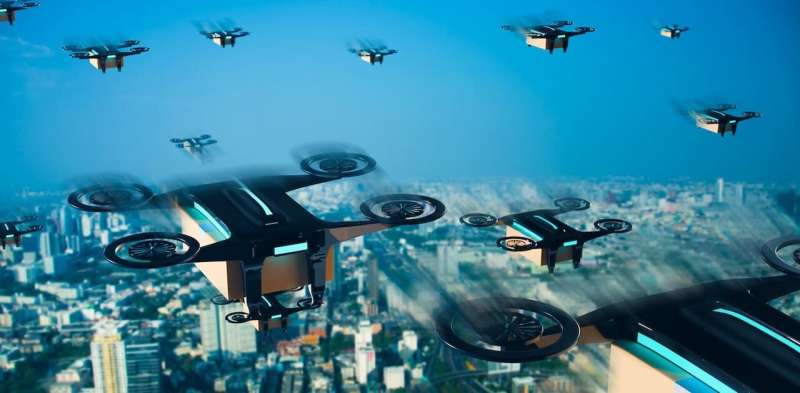
  • The True Prices of Delivery drones

    The True Prices of Delivery drones

    At the world’s deepest cave pit, a robot aids researchers in breaking a record.
    At the world’s deepest cave pit, a robot aids researchers in breaking a record.

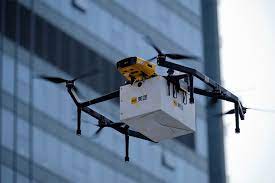
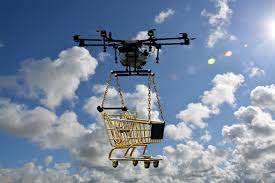
    The Commonwealth Department of Infrastructure covertly developed “drone delivery standards” with industry stakeholders and solicited public feedback on the proposal at the beginning of November. Drones.gov.au, a snazzy new website, boasts of the alleged advantages of delivery drones. It asserts that they will boost the economy, offer cost effectiveness, and preserve the environment.

    The proposed rules put the most emphasis on safety and noise concerns, as well as the most basic technical aspects of land-use planning (suggesting that drones don’t require any specific accommodations). These concerns are important, but they completely ignore the risks associated with allowing delivery drones to take over our skies.

    Then there is the issue of whether the alleged benefits can be verified. The assertions stated in the department’s recommendations have been put to the test by our team at the Minderoo Tech & Policy Lab at the University of Western Australia. What you need to know is this.

    Drone delivery networks would be a big deal.

    Drones have a lot of potential to replace humans in risky or otherwise challenging (but crucial) tasks including emergency assistance, aerial mustering, and shark patrol. Drones used for commercial deliveries, though, are a completely different matter.

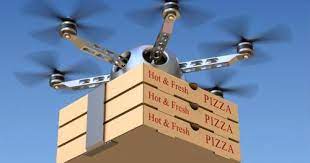
    The main force behind them is Wing Aviation, a division of Alphabet Inc., the holding company for Google. Wing has chosen Australia as its primary test country for its on-demand coffee, roast chicken, Coke, and chip deliveries. This is a visceral (even violent) encroachment on public space, not to mention a public health and environmental catastrophe waiting to happen.

    Wing has been in business since September 2017 in a few ACT locations, and since September 2019 in Logan, Queensland. Even though the operations are completely free for both businesses and customers, objections have been raised. Noise and safety problems, as well as effects on animals, pets, and privacy, have all been causes for concern.

    Following intense opposition from the locals, Wing was forced to stop operations in Bonython. Up to eight loud deliveries can be received by neighbors in Logan each hour, according to locals who claim to be alarmed.

    In recognition of how road infrastructure leads to socioeconomic injustice, pollution, and a lower quality of life, cities all over the world are looking for alternatives to highways. Do we want these issues to recur in our skies?

    Unproven benefits of delivery drones

    The guidelines underline the economic and environmental potential of a future with many drones. It is obviously alluring to add A$14.5 billion to Australia’s GDP and 10,000 employment over the following two decades. But does the evidence support this optimistic outlook?

    The figures included in the recommendations were actually taken from a Deloitte Access Economics report from October 2020 that was created for the Department of Infrastructure.

    Crucially, the report aggregates multiple markets for drone use, well beyond just delivery. In the Deloitte report, the segment of the drone market for military and industrial applications is estimated to grow to more than $5.5 billion, while the food delivery market, at $0.26 billion, is at best 20 times smaller. It appears military and industrial applications drive the bold economic estimates found in the guidelines—yet the department doesn’t mention them.

    Also, the 2020 report caveats if its predictions of market expansion change, so too will its economic analysis. Australia’s highest inflation rate in more than 30 years, coupled with a global economic slowdown, and worsening business confidence suggests Deloitte’s predictions are perhaps on shaky grounds.

    The fragility of the economic promise is matched by equally shallow claims of environmental sustainability. There is a shrewd focus on “last-mile delivery emissions” to demonstrate drones’ green credentials. But this ignores the emissions generated along the entire logistics chain of this complex, technology-heavy system.

    Before we even consider the growth in single-use packaging, while reusable coffee cups and containers linger at the back of the cabinet, there are compounded emissions caused by additional warehousing and the power needs of drones.

    Drones of luxury rather than necessity

    According to the regulations, drones provide “on-demand supplies.” This begs the question, by whom demanded? Deliveroo entered voluntary administration in Australia a mere two weeks ago, claiming “difficult economic conditions.”

    The phrase “on-demand supply” carries a lot of baggage since it confounds want with need, conflating donuts with prescription medication. This literary device presents drones as an all-or-nothing proposition, which is obviously inaccurate.

    Supporting the only other authorized drone delivery company in Australia, the local medical supplier Swoop Aero, is possible without having to put up with the neighbors down the street receiving repeated deliveries of fast food.

    The consent of the people should be required.

    n 2002, Australia became the first country to regulate civilian drone use. The intervening 20 years have afforded the drone industry multiple opportunities to influence the regulatory process, mostly beyond the public eye. Delivery drones necessitate an entirely different conversation.

    In 2019, some unsuspecting Canberrans only discovered they were guinea pigs in a food delivery drone trial when the drones began to appear on their neighbor’s doorsteps. They then found out the company responsible, Google Wing, also runs the public feedback process on behalf of the government. Such events do not deliver the transparency and impartiality demanded of government decision-making.

    Drones call for a wide-ranging conversation on the important, living environment above our heads. We need to put the much broader needs of all living beings first and reject hollow promises and indulgence.

    Google hopes to develop the future of drone deliveries in Australia before bringing it to other countries. Australians have a chance to reverse this strategy. The deadline for comments on the draft guidelines is December 2. You can then voice your opinion here.

    Read More

    Conclusion

    Robot are really helping a lot when it comes to delivery. The scientist has make easier for us by building a robot know has drone. This robot is fast and good in delivery. You can tell can tell us what you think about the delivery drones, just drop your comment on the comment section .

  • smartening up “transport” robots.

    smartening up “transport” robots.

    smartening up "transport" robots.
    smartening up “transport” robots.

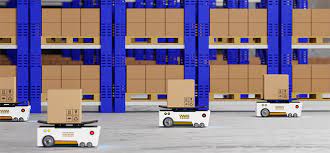
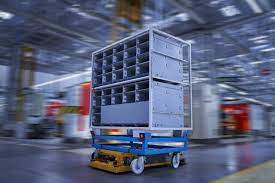
    smartening up “transport” robots; imagine a team of humans and robots collaborating to handle online orders. Human employees would be strategically placed among their robotic teammates, who would be intelligently traveling back and forth in a warehouse, selecting items to transport to customers. Thanks to University of Missouri researchers who are aiming to accelerate internet delivery by creating a software model aimed at making “transport” robots smarter, this may become a reality sooner rather than later.

    According to Sharan Srinivas, an assistant professor who holds joint appointments in the departments of Industrial and Manufacturing Systems Engineering and Marketing, “the robotic technology currently exists.” “Our aim is to plan effectively in order to make the best use of this technology. For example, “How do you optimize the route plan for the human pickers and robots given a list of goods to pick?” “How many items should a robot pick in a given tour?” or “In what order should the items be collected for a given robot tour?” The human worker will also be asked a similar series of questions. Optimizing the strategy for cooperation between robots and human pickers is the hardest aspect.”

    smartening up "transport" robots.

    Currently, fulfilling internet orders requires a lot of labor and costs money. Collaborative robots, sometimes referred to as cobots or autonomous mobile robots (AMRs), have already been developed by robotic firms to work in a warehouse or distribution center to help optimize this process. The AMRs have sensors and cameras to aid in guiding them around a controlled environment, such as a warehouse. According to Srinivas, the suggested strategy will accelerate client order fulfillment by enhancing the fundamental choices or issues surrounding cooperative order selecting.

    The robot is intelligent, so if it is told to travel to a specific place, it can navigate the warehouse without running into any people or other barriers, according to Srinivas.

    Srinivas, who specializes in data analytics and operations research, said AMRs are not designed to replace human workers, but instead can work collaboratively alongside them to help increase the efficiency of the order fulfillment process. For instance, AMRs can help fulfill multiple orders at a time from separate areas of the warehouse quicker than a person, but human workers are still needed to help pick items from shelves and place them onto the robots to be transported to a designated drop-off point inside the warehouse.

    smartening up "transport" robots.

    AMRs are not intended to replace human workers, according to Srinivas, an expert in data analytics and operations research, but rather to work cooperatively alongside people to boost the effectiveness of the order fulfillment process. AMRs, for example, can complete orders from different parts of the warehouse more quickly than people can, but people are still needed to pick products off shelves and load them onto the robots so that they may be carried to a predetermined drop-off location inside the warehouse.

    smartening up "transport" robots.

    The inability of these robots to grasp objects well is their one disadvantage, according to Srinivas. “We are attempting to combine the strengths of both resources—human workers and collaborative robots—because humans are skilled at grabbing objects. In this instance, the people are dispersed around the warehouse, so rather than having one worker traverse the entire aisle and pick up many products along the way, the robot will approach the human worker, who will then grab an item and load it onto the robot. As a result, the human worker won’t have to exert too much effort to wheel bulky carts containing heavy things around the warehouse.”

    In the future, Srinivas added, their program might potentially be utilized in other places, like grocery shops, where robots might be employed to fulfill orders while simultaneously navigating around customers. He anticipated that this might occur during the next three to five years.

    The International Journal of Production Economics published an article titled “Collaborative order picking with multiple pickers and robots: Integrated approach for order batching, sequencing, and picker-robot routing.” The study’s co-author is Shitao Yu, a PhD candidate in the MU Department of Industrial and Manufacturing Systems Engineering.

    Read More

  • There Are Five Ways That Drones Will Alter How Buildings Are Planned.

    There Are Five Ways That Drones Will Alter How Buildings Are Planned.

    There are five ways that drones will alter how buildings are planned.
    There are five ways that drones will alter

    There are five ways that drones will alter; they are utilized for safety improvement, building planning, history preservation, and development. However, research by the UK’s Department of Transport has shown that many members of the public have a limited awareness of the potential practical applications for drones.

    It’s critical that the majority of people comprehend how drones are impacting our future. We believe that this succinct summary of five ways that drones will effect building design will provide some insight into how things are likely to develop as specialists in design futures and mobility.

    1. Creating digital building models
      Drones may capture pictures of structures, which are then utilized to create 3D models of those structures in CAD software.

    These models can be integrated with other information, such as 3D interior scans taken with drones or laser scanners, to give surveyors, architects, and clients an extremely realistic representation of the structure. They are accurate to within one centimeter.

    By giving architects and planners access to a single source, using these digital models expedites and reduces costs associated with the construction process.

    1. Heritage-themed simulacra

    Using theatrical outdoor drone performances at damaged national heritage sites including the Colosseum in Rome, Notre Dame in Paris, and Gaud’s Sagrada Familia in Barcelona, Studio Drift is a multidisciplinary group of Dutch artists.

    There are five ways that drones will alter how buildings are planned.
    1. Drones using 3D printer mounts.
      Drones with mounted 3D printers have been the subject of two research projects from the architecture, design, planning, and consulting firm Gensler and another from the Empa consortium, which is led by Imperial College London and includes University College London, University of Bath, University of Pennsylvania, Queen Mary University of London, and Technical University of Munich. These drones would work quickly to create emergency shelters or repair structures at great heights, without the need for scaffolding, or in challenging to access situations, enhancing safety.

    Gensler has already employed drones to repair wind turbines, and scientists at Imperial College are investigating drone swarms that function like bee hives and collaborate to create blueprints. In a project dubbed Aerial Additive Manufacturing, drones work in concert to follow a predetermined course. For the time being, the endeavor consists solely of a technology demonstration rather than actual construction work on a structure.

    Drones with mounted 3D printers may one day speed up the production of highly personalized buildings, but it is yet unclear how this will affect the labor force and what it would mean for manual labor positions.

    1. Flexible security
      As an alternative to the static, immovable character of existing technologies like closed-circuit television, drones provide new opportunities for monitoring.

    The next phase of surveillance likely will involve the use of drones with cameras and sensors that rely on sophisticated software programs like “facial recognition” and biometric markers, as well as providing security monitoring for private citizens. Drones would probably be equipped with monitoring equipment that might connect to security or law enforcement agencies.

    This kind of drone utilization could make our structures more receptive to incursions and climate-adaptable. Drones may move parts of the building such as shade-creating devices, following the path of the sun to stop buildings overheating, for example.

    Read More

  • At the world’s deepest cave pit, a robot aids researchers in breaking a record.

    At the world’s deepest cave pit, a robot aids researchers in breaking a record.

    At the world's deepest cave pit, a robot aids researchers in breaking a record.
    deepest cave pitd

    A special natural wonder that is not (yet) popular on Instagram is located in the small Czech city of Hranice. A team of experts just broke a record by learning more about the depth of the Hranice Abyss, the world’s deepest underwater cave pit.

    This cave pit is said to have been created by the sinkhole-like structure of the earth layer collapsing, exposing the vertically stacked enormous body of water beneath. The abyss may be deeper than 1000 meters, according to the most recent estimations based on the temperature and chemical study of the water.

    Numerous excursions have been made in an effort to learn more and more about the Hranice Abyss. Based on observations made by divers up to a depth of about 180 meters, the first maps were created. Krzysztof Starnawski launched a probe in 2014 from a height of 217 meters, which traveled 384 meters. Even though it extended well beyond what would be humanly conceivable, it was still unable to see the cave’s floor.

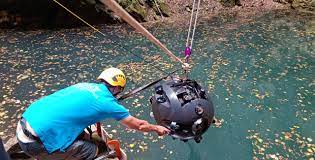
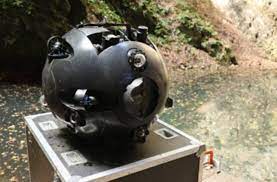
    In cooperation with the Czech Speleological Society, UNEXMIN GeoRobotics, and the University of Miskolc, a group of Portuguese researchers from the Institute for Systems and Computer Engineering, Technology and Science (INESC TEC) deployed the UX-1Neo robot, which has a reach of 450 meters, on August 1st.

    deepest cave pit

    UX-1Neo is a hybrid ROV/AUV robot that can operate either autonomously or with remote supervision. Its advanced navigation and sensors allow it to obtain a precise perception of the environment and to know its position precisely, this was proven to be a crucial advantage in exploring the Czech wonder.

    In addition to breaking the exploration record, UX-1Neo provided a detailed map of the cave, which was impossible to achieve before.

    “The Remotely Operated Vehicle—ROV did not have a positioning and navigation system, so it could only be piloted by a very experienced operator, based on the images transmitted by the robot,” explains Alfredo Martins, researcher from INESC TEC. UX-1Neo stands out for being an “underwater robot with precise positioning, and having unique characteristics allowing it to perform missions where no other robot can operate”.

    The exploration of underwater caves is not exactly straightforward. For starters, they are not straight but rather narrow zig-zagging tunnels where the light gets dimmer and dimmer as one gets farther from the surface. Also, the geological structures might be unstable and even collapse, which presents a serious threat to both divers and robots, not to mention branches, twigs, and other debris that the dark waters hide and can get explorers and vehicles stuck in its depth.

    The UX-1Neo is packed with features that make it the most technologically advanced underwater vehicle considering its volume and weight. It has built-in sonars, cameras, thrusters, structured light systems, floating systems and much more. It even also features a Hyperspectral unit that collects and processes information from across the electromagnetic spectrum. But what can these sensors tell about the pits and caves the UX-1Neo can explore?

    “The UX-1Neo incorporates six structured light systems that allow us to build a detailed 3D map of the area we are exploring. During our mission in Czechia, we were able to create such a map in two days, something that the community has been trying to achieve for 50 years”, adds Alfredo Martins.

    “The mission made it possible to successfully explore the cave up to 450 meters,” achieving the UNEXUP project’s goals which are “to create a new mine mapping service based on a new class of autonomous underwater robots capable of exploring up to a thousand meters of depth, obtaining relevant information such as structural state and map of the same (allowing to know if there were landslides or other problems) and geological information important to determine existence of mineral resources of economic interest, which would otherwise be more difficult and dangerous to obtain or would have higher costs.”

    Humans’ desire for the unknown is what motivates cave exploration. The history of the world can be accessed through underwater cave pits, especially ones that are as deep as the one in Hranice. Its cold, dark waters hold unprocessed knowledge about how the planet and life have changed over time, typically with little to no human interference. Even though Voyager 1 will travel 10.4 billion kilometers through space, there are still a lot of unanswered questions about our tiny blue planet.

    Read More

  • Could artificial intelligence contribute to the creation of a more morally sound technological environment?

    Could artificial intelligence contribute to the creation of a more morally sound technological environment?

    Could artificial intelligence contribute to the creation of a more morally sound technological environment?
    Could artificial intelligence contribute

    A robot may not intentionally damage a person or, by remaining motionless, permit a person to suffer harm. A robot must follow any instructions provided to it by humans unless doing so would violate the First Law. As long as it does not violate the First or Second Law, a robot must defend its very existence.

    Isaac Asimov outlined The Three Laws of Robotics eighty years prior to the development of artificial intelligence. However, they wonderfully demonstrate how we as a species have responded to the moral dilemmas presented by technology: by safeguarding the users.

    However, whether or not they are caused by technology, the ethical problems that humanity is currently confronting are more of a social issue than a technological one. In light of this, technology in general, and artificial intelligence in particular, could be utilized to empower users and lead us toward a future that is more ethically desirable. To put it another way, we can reconsider how we develop technology and artificial intelligence and use them to create a society that is more moral.

    In his open-access article titled “Ethical Idealism, Technology and Practice: a Manifesto,” which was published in Philosophy & Technology, Joan Casas-Roma, a researcher at the SmartLearn group affiliated with the Faculty of Computer Science, Multimedia and Telecommunications at the Universitat Oberta de Catalunya (UOC), proposed this strategy. We need to go back in time a little bit in order to comprehend how to achieve this paradigm shift.

    Isn’t artificial intelligence a neutral concept?

    In comparison to now, the world was quite low-tech when Asimov originally published his laws of robotics. In 1942, Alan Turing had just begun formalizing the algorithmic ideas that would later play a crucial role in the creation of modern computing. Computers, the internet, and even robots that could operate on their own were nonexistent. But Asimov foresaw the anxiety that would arise if humans were successful in creating machines that were so sophisticated that they would eventually rebel against their masters.

    But this was not the case. We came to realize that the data and the algorithms replicated the model or worldview of the person who was using the data or who had designed the system. In other words, the technology itself was not eliminating human biases, but rather transferring them to a new medium. “Over time, we have learned that artificial intelligence is not necessarily objective and, therefore, its decisions can be highly biased. The decisions perpetuated inequalities, rather than fixing them,” he said.

    As a result, we have arrived at the spot where the Laws of Robotics predicted. From a defensive and reactive stance, concerns concerning ethics and artificial intelligence were raised. We made the decision to take action to limit the negative consequences of artificial intelligence once we discovered that it was neither fair nor objective. “The necessity to create a barrier to stop the negative impacts of technology on people from reoccurring gave rise to the ethical dilemma of artificial intelligence. To do so was required, “affirmed Casas-Roma

    What ethically desirable outcomes might a group of artificial intelligences with access to an unprecedented amount of data help us to achieve, he explains in the manifesto, has prevented us from exploring another fundamental question in the relationship between technology and ethics over the past few decades. To put it another way, how might technology aid in the development of an ethically desirable future?

    In the direction of an idealistic alliance between ethics and technology
    Moving toward a more inclusive, interconnected, and cooperative society where people have a better knowledge of global concerns is one of the primary mid-term goals of the European Union. Technology and artificial intelligence may be a significant barrier to achieving it, but they may also be a valuable ally. A more cooperative society “may be fostered depending on how people’s relationship with artificial intelligence is designed,” said Casas-Roma.

    There has been an undeniable boom in online education in recent years. Digital learning tools have many benefits, but they can also contribute to a sense of isolation. “Technology could encourage a greater sense of cooperation and create a greater sense of community. For example, instead of having a system that only automatically corrects exercises, the system could also send a message to another classmate who has solved the problem to make it easier for students to help each other. It’s just one idea to understand how technology can be designed to help us interact in a way that promotes community and cooperation,” he said.

    According to Casas-Roma, an ethical idealist perspective can rethink how technology and the way users use it can create new opportunities to achieve ethical benefits for the users themselves and society as a whole. This idealistic approach to the ethics of technology should have the following characteristics:

    Expansive. Technology and its uses should be designed in a way that enables its users to flourish and become more empowered.
    Idealist. The end goal that should always be kept in mind is how technology could make things better.
    Enabling. The possibilities created by technology must be carefully understood and shaped to ensure that they enhance and support the ethical growth of users and societies.
    Mutable. The current state of affairs should not be taken for granted. The current social, political and economic landscape, as well as technology and the way it is used, could be reshaped to enable progress toward a different ideal state of affairs.
    Principle-based. The way technology is used should be seen as an opportunity to enable and promote behaviors, interactions and practices that are aligned with certain desired ethical principles.
    “It’s not so much a question of data or algorithms. It is a matter of rethinking how we interact and how we would like to interact, what we are enabling through a technology that imposes itself as a medium,” concluded Joan Casas-Roma.

    “This idea is not so much a proposal concerning the power of technology, but rather the way of thinking behind whoever designs the technology. It is a call for a paradigm shift, a change of mindset. The ethical effects of technology are not a technological problem, but rather a social problem. They pose the problem of how we interact with each other and with our surroundings through technology.

    Read More

  • Seattle entrepreneurs use robots to prepare coffee and pizza.

    Seattle entrepreneurs use robots to prepare coffee and pizza.

    Seattle entrepreneurs use robots to prepare coffee and pizza.
    Robot Making Coffee and pizza

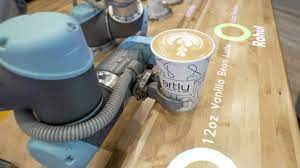
    To prepare a cup of cappuccino, Jarvis travels slowly but methodically from one station to the next. Robots to prepare coffee and pizza. Jarvis prepares the espresso, pours the milk, steams the foam, and assembles everything before adding a skillfully crafted foam leaf on top.

    The outcome is a finished cup of cappuccino.

    What distinguishes this cappuccino from others? its creator. At Artly in Pike Place Market, Jarvis is a robotic arm rather than a human barista.

    While Jarvis is occupied, human staff members concentrate on interacting with clients, introducing newbies to the concept, and taking orders via tablet.

    The 2020-founded Seattle-based robotics business Artly operates seven facilities in California, Oregon, and Washington. A distinctive barista bot with its own name, gender, voice, accent, and personality is the center of attention at each location. As they learn from a different human barista at each site, the robot’s methods vary.

    Seattle entrepreneurs use robots to prepare coffee and pizza.

    Although it is fascinating to witness how the robot makes coffee, the innovation was driven by urgent commercial demands. Even before the pandemic struck and presented new difficulties, cost concerns and frequent personnel turnover in the food services industry prompted Artly and others to provide automated solutions to restaurants and companies.

    After only a few years in business, Artly CEO Meng Wang claimed that by cutting out the biggest cost in the food industry—labor—the business has been able to maintain excellent operating margins.

    In addition to a barista robot like Jarvis, Artly requires one employee for a coffee business that would require two or three baristas. According to Wang, Artly uses the money it saves on labor to buy additional high-quality coffee.

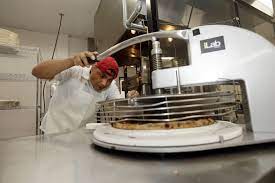
    Artly is not the only company that use robot assistance for food preparation. Pizza, a mainstay of the American diet, is the focus of automation solutions provided by Picnic, another Seattle-based business. With metered toppings, its food prep unit can make up to 100 pizzas in one hour.

    Pizzas have been built by Picnic’s robots in a variety of locations since the company was formed in 2016, including Seattle’s T-Mobile Park and the Las Vegas Convention Center. The business has noticed an increase in interest in its robots. This summer, Picnic announced collaborations with a Domino’s outlet in Berlin and the West Seattle pizzeria Moto.

    These robots’ manufacturers boast that their automated solutions would increase productivity and cut costs. According to Clayton Wood, CEO of Picnic, automating pizza assembling can help businesses cut down on food waste and possibly save money. For instance, it makes the toppings more evenly distributed.

    Pizza-making can be more economical by automating the process with predetermined topping amounts, according to Wood.

    Automated solutions also close a hiring and retention gap. According to Wood, positions in the food industry can be “tedious and can be dangerous, and there’s very rapid turnover.” “There is no room for progress, and the working environment is not good.”

    According to Geoff Harris, a Picnic investor and the co-founder and managing partner of the venture capital firm Flying Fish Partners, problems with efficiency and turnover in the food business predate COVID-19. 

    However, as restaurants shuttered due to the pandemic, the need increased. Many employees were laid off or furloughed and did not go back to the food industry.

    Staffing levels at eating and drinking establishments remain below their pre-pandemic levels as demand for labor nationally remains high, according to a National Restaurant Association analysis of U.S. Labor of Bureau Statistics data in November.

    human contact


    However, there are some situations where people cannot replace robots. Joe Yang, co-founder and chief coffee officer of Artly and owner of a number of coffee shops in Portland, has firsthand experience with this.

    Yang used his own stores to test the beta version of Jarvis. The robot barista first piqued the interest and excitement of his customers, but the service was slower than it would have been with a human barista. Customers wanted to feel connected to the person pouring their coffee, he claimed.

    Customers expect to be helped by a human when they visit a coffee shop, according to Yang.

    As a result, Artly has prioritized opening sites in commercial office buildings and shopping malls rather than traditional coffee shops.

    In regions where there are no coffee shops due to the epidemic or where Starbucks locations have closed, Artly has also found an opportunity to grow.

    “There were several ‘coffee deserts’ during COVID-19, and the competition is obviously much less than previously,” Wang added.

    For instance, in May 2021, the company’s first shop in Portland, Oregon, opened, following the departure of the previous coffee operator due to a staffing shortage. Similar to this, in December 2021, Jarvis established a residence at Stoneridge Shopping Center in Pleasanton, California, because there wasn’t a coffee shop there.

    Customers had no other coffee options once Starbucks departed because it was the only coffee supplier in some locations, according to CEO Wang. This was the situation in San Antonio’s Stonestown Galleria Shopping Center.

    CEO Wang of Artly claimed that money has not been an issue for the business. It completed a $8.5 million investment round this year and a $1.5 million round the previous year. Early-stage investments were made in both rounds.

    Picnic and Artly are both still fledgling businesses. And all parties intend to grow the business despite any potential economic difficulties.

    The reveal date is still pending, but Picnic and Moto have teamed together once more to create a food prep station at the pizzeria’s downtown location. Wood and Harris predict further collaborations in the future.

    The next stage at Artly, according to Wang, will be franchising when the barista bots are more consistent and dependable at brewing coffee, albeit that objective is still a few years away. The company intends to scale by 2023

    Read More

  • How to Make Money Using ChatGPT

    How to Make Money Using ChatGPT

    Knowing What ChatGPT is

    Make Money Using ChatGPT
    ChatGPT interactive dashboard

    Before venturing into business with ChatGPT, you have to know what it is and how it works. Open AI ChatGPT is an advanced Artificial Intelligence made to respond and give answers to questions, acknowledge mistakes, disapprove wrong requests and possibly challenge false assumptions. It is not just a tool but users can present it to reply  questions unless those questions are useless.

    Read More

    How to Make Use of ChatGPT

    Make Money Using ChatGPT

    Generative Pre-trained Transformer (ChatGPT) can be used in many ways to make money online since it’s faster, reliable and updated in most anything in the world. It can be effective in anything whether describing jobs, writing scripts and more, and how surprised you will be fast it goes. Now we talk about ways we can make money.

    How to Make Money Using ChatGPT

    Writing Music Lyrics of Any Type

    Make Money Using ChatGPT

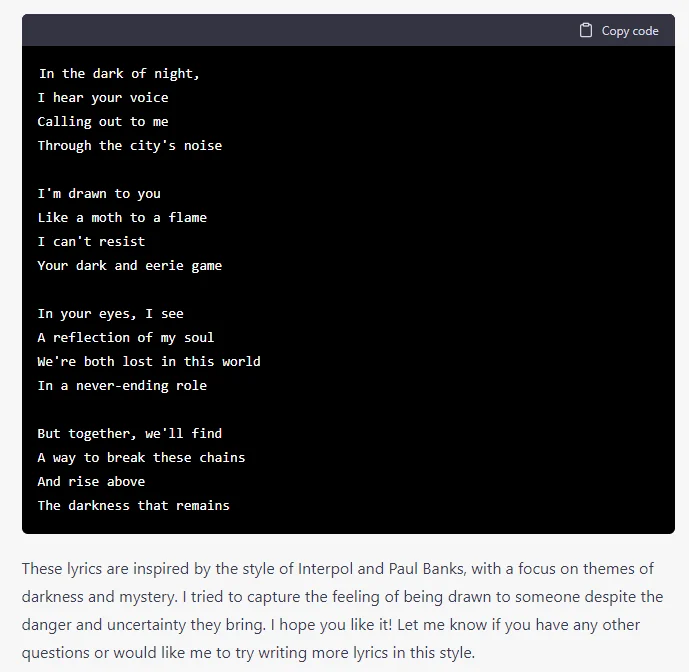
    Unlike other AI solutions, ChatGPT can be used to write any type of music lyrics provided that there is a theme or topic of the music that should be made. ChatGPT was asked to write Interpol lyrics, and it wrote this below.

    Make Money Using ChatGPT

    This means that you can begin to write music lyrics for singers or yourself using this AI tool. Some musicians and singers pay lyricist big to come up with good lyrics for their next songs or raps. This can be a good way for you to carve out a niche.

    Making contents in many languages

    using ChatGPT to translate

    Wanting to reach a much wider audience of different languages faster, as a content writer, ChatGPT is reliable as it translates posts in different languages without much stress. 

    Solve math puzzles

    Using ChatGPT to solve math

    There are many tricky math out there, difficult to solve but ChatGPT have shown us how useful it is by being able to solve math puzzles in a matter of seconds and all you need is to type in the questions and wait for the reply. And what is more? ChatGPT solves in an orderly manner and simple to understand. And an online tutor or teacher can make use of this advanced tech to make money.

    Essay writing

    using chatGPT to write an essay

    ChatGPT can write essays on any topic, and you can make money using it to write an essay on a topic of your choice with the best words. Although it is recommended that one write his essay, ChatGPT is faster, and of course, who doesn’t want faster work?

    Article writing

    using chatGPT to write article

    There are many digital markets that require articles to run their marketing websites. One can make money through this by providing writing services and making freelance account on the online market.

    Copy writing

    doing copywrite with ChatGPT

    Since copywriting encourage reader to perform an action, ChatGPt makes it easy for one to copyright about a topic by being faster as people are looking for copywriters that are good in order to boost their digital market. This can bring money to any copywriters. 

    Conclusion

    ChatGPT AI has come to stay and has been making a lot of money for people who has mastered it in the various fields outlined above. This post has detailed and outline various ways to make money using ChatGPT AI online. Let us know what you think of such post. Did it help you or you already knew these?

  • How Robot in Miami is Delivering Food to Uber Eats Users.

    How Robot in Miami is Delivering Food to Uber Eats Users.

    Look there: See a robot in Miami delivering food to an Uber Eats user.
    Food Delivery Robot

    A robot in Miami delivering food haveA little autonomous vehicle approaches a person on the sidewalk and stops. The person then reaches below, opens the hatch, and removes the ordered meal. This is not a scene from a science fiction film; rather, it is the launch of Miami-Dade residents’ access to Uber Eats’ newest method of food delivery.

    Cartken, a technology firm based in California, and Uber announced a partnership on Thursday that will allow Cartken’s self-driving robots to fulfill customer orders for Uber Eats. For the time being, the robot can deliver food to residents in the Dadeland neighborhood.

    aims to extend its robot meal delivery service to additional cities and college campuses around the country, in addition to the remainder of Miami-Dade County. On the campuses of Ohio State University and the University of Arizona, as well as in several locations in California, Canada, the United Kingdom, Germany, and Japan, Cartken’s robots are currently delivering food.

    Look there: See a robot in Miami delivering food to an Uber Eats user.

    Customers who live in areas where automated delivery is possible are not charged extra to have food delivered to them by a robot. They are informed via their Uber app that a robot will handle delivery, and they will receive updates on its whereabouts until it comes. Customers use their smartphones to open the robot’s storage compartment when it arrives and remove the food they purchased.

    In addition to the remainder of Miami-Dade County, the company wants to expand its robot meal delivery service to additional cities and college campuses across the nation. Cartken’s robots are currently delivering food on the campuses of Ohio State University and the University of Arizona, as well as in a number of places in California, Canada, the United Kingdom, Germany, and Japan.

    There are no additional fees for automated delivery for customers who reside in certain areas. They are notified that a robot will manage delivery via their Uber app, and they will get updates on its whereabouts until it arrives. When the robot arrives, customers use their smartphones to enter the storage compartment and take the meal they ordered.

    In a statement, Bersch said, “We are thrilled about how this relationship with Uber can bring the benefits of robotics to food delivery—and ultimately create more connected communities. Together, we have the chance to lessen traffic congestion, support neighborhood businesses in expanding their delivery capabilities, and provide fast, convenient, and emission-free deliveries to customers.

    Cartken and Miami-based digital company Reef collaborated in 2021 to develop a delivery service for the city’s urban ghost kitchens. For automated food delivery, a quarter-mile radius around Brickell or downtown Miami was required.

    Read More